Contemplation by Laurence Connor
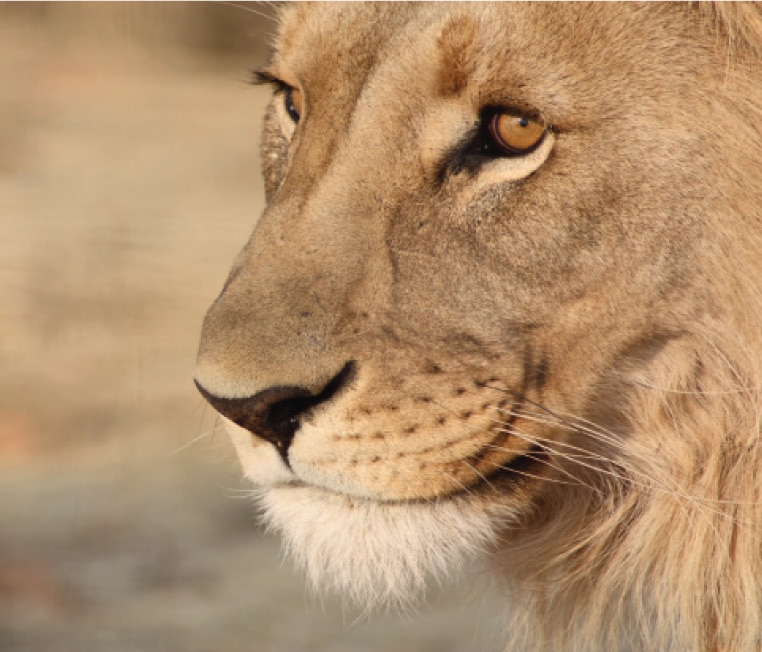
Captured on a reserve west of Windhoek, Namibia, this striking image documents a rare and intimate encounter with a lion. While participating in a guiding internship and carnivore conservation program, the photographer found himself on foot, crouched behind the protective cover of an Acacia mellifera. The resulting shot captures a moment of profound stillness and raw intensity, highlighting the photographer's patience and proximity to the wild. This photograph is award-worthy for its ability to convey the quiet, powerful essence of a predator in its natural habitat, demonstrating both technical precision and a deep, respectful connection to the African wilderness.
Laurence Connor
Raised in the English counties of Norfolk and Kent, Laurence Connor developed an early passion for travel and the natural world. After training as a Nature Guide in South Africa, he dedicated his time to wildlife conservation in Namibia and the Lower Zambezi, gaining hands-on experience in animal rehabilitation. His background as a guide and photographic tutor informs his work, which has been featured in exhibitions such as The Bush & Beach Series. Connor is recognized for his extensive knowledge of the African wilderness and his commitment to conservation.
Resonance Score Breakdown
Transparency Note: The resonance score (13.2/20) is calculated based on social engagement metrics collected before the award announcement.
Expert Photography Reviews · 5
The Weight of the Gaze
I remember sitting in a small cafe in Luang Prabang, watching an old man watch the river. He didn’t have a book, a phone, or a companion. He just sat there for an hour, his eyes tracking the slow drift of the water, his posture completely still.
Read the reflection →The Weight of a Gaze
I was walking through the park this morning when a stray cat stopped dead in its tracks. It didn't run. It didn't hiss.
Read the reflection →Reviews & Comments
Share your thoughts about this award-winning photograph. Your reviews contribute to the community engagement score.
The lion doesn’t merely exist; it emerges from the void of the Namibian scrub. Connor’s lens finds the predator’s gaze, but it’s the encroaching darkness of the Acacia that truly haunts me. I’ve spent hours staring into those deep, velvet blacks, feeling the cold weight of a silence that refuses to be tamed. It’s a brutal, honest confrontation. When I look at this, I don’t see a wild animal. I see the shadow of our own mortality.
Most wildlife shots are just trophies, but this one holds a quiet, unsettling tension. I’ve seen thousands of lions, yet the way the Acacia branches frame this gaze makes me feel like I’m the one being hunted. It’s not just the proximity; it’s the stillness. While others rely on aggressive action, Connor’s restraint turns a simple encounter into a haunting memory. I’d bet this image will still feel dangerous thirty years from now.
Before the eye identifies the lion, something in the chest tightens. It’s the sudden, primal recognition of being watched. Connor’s frame doesn’t just show a predator; it forces a physiological stillness, a held-breath moment where your pulse slows to match the cat’s gaze. I’ve returned to this shot for years, and that amber stare still triggers a phantom shiver. It’s not about the acacia; it’s about the terrifying, quiet intimacy of being preyed upon by light.
The lion’s gaze creates a datum line that anchors the entire frame. Crouched behind the Acacia, Connor captures the tension between solid and void, where the predator’s mass defines the space around it. It’s a rare moment where the wild environment feels like a constructed room. I’ve spent my career analyzing buildings, but this raw, predatory stillness makes me feel small. It’s a spatial experience that architecture rarely achieves, stripping away everything but pure, terrifying presence.
The lion’s gaze anchors the frame, creating a rigid fulcrum against the blurred acacia. It’s a precarious balance. The negative space to the left provides necessary breathing room, preventing the subject from collapsing into the periphery. I’ve rarely seen such disciplined geometry in wildlife work. The aperture choice forces a shallow depth of field that isolates the predator’s intensity. It doesn’t rely on sentiment. The visual architecture holds, and frankly, it’s quite sharp.
Thanks Sue, fingers crossed it does will in the photo of the month competition :)
This is a stunning image. Beautifully composed.